For the owner with better reviews and a real office who keeps asking the same thing: why do customers choose my competitor when my service is better?
Not long ago, my partner was shopping for something from an expensive clothing brand. He searched on Google, and Google’s AI Overview pointed him to a clearance sale. The shop’s name was almost identical to the real brand, and it sat higher on Google than the brand’s own website. An item that normally costs $800 was selling for $80.
I looked at it and it felt wrong. When a deal is too good to be true, it usually is. He wasn’t worried. In his words, the AI recommended it.
Then the payment page started glitching. He was so sure that he tried a second card. Neither payment went through, and we blocked both cards straight away. We were lucky.
Think about what happened there. The real brand had the reviews and the history. The fake shop had none of that, and it still won the click, because it showed up first and an AI vouched for it. If AI can lend that much trust to a fake shop, it can lend it to your competitor every day.
Key takeaways
- You lose at two moments. Before the customer sees you, and after they compare you with someone they’ve heard of more.
- Google and AI can’t try your service. They judge you by how well known you are, so being better stays invisible until other places say it.
- Good reviews are not enough on their own. Plenty of businesses with great reviews never get named by AI.
- The biggest lever is what other trusted places say about you. AI repeats what it reads, in as many places as it finds it.
- One hour a week is enough to start. Spend it on the part only you can do: answering one real buyer question in your own words. Getting it published widely is the bigger job.
Why do customers choose my competitor when my service is better?
Customers choose the business they see first and hear about most. Quality only counts once someone can see it. Your customers can’t feel your service until they book, so they go by what they can see: who comes up, and who other people talk about.
Said plainly
Being better doesn’t count until other people say it, in places your customers and AI can see.
That choice happens at two moments, and most owners only look at one of them. The first is the search: does your name come up at all? The second is the comparison: when the customer sees you next to a rival, do they trust you more? The two sections below take them one at a time.
Why do my competitors always show up first?
Owners ask this question in public all the time. I read through public forums where small business owners ask for help, and the same frustration comes up again and again.
Below are four of those questions, worded the way the owners asked them, and what is really going on in each. They are public posts, paraphrased, and the details are each owner’s own account.
Why do competitors with fewer reviews show up before me?
A massage therapist, three months into their practice, searched for massage in their own town. Businesses from farther away came up first, some with fewer reviews and lower ratings. They had filled in their hours, services, photos, and description, and couldn’t see what else there was to do.
Reviews are only one part of how Google decides who is well known. A rival that has been around for years has been mentioned, linked, and searched for far more often. A finished profile gets you into the race, but it doesn’t put you at the front. That is the usual reason competitors show up before you even when your reviews are better.
How is a competitor with no reviews ranking above me on Google Maps?
A roofer with 15 years in business, more than 200 five-star reviews, and a real office watched three new listings jump above them on Google Maps. The listings had generic names and almost no reviews, and one address, the owner says, was an empty lot. Their calls dropped. Two SEO firms told them to post more and get more reviews.
When a competitor with no reviews is ranking above you, check first whether the business is real. Fake listings exist, and you should report them (see the questions at the end). But more reviews was the wrong advice for an owner who already had the most in town. What the roofer lacked was being talked about outside Google Maps.
I did everything on the checklist. Why am I still not first?
Another owner listed everything they had done: a full profile, new photos, the same details on every site, as many reviews as their competitors, and a post every few days. They asked which tool they were missing to rank higher on Google Maps.
The checklist is the entry ticket. Every serious competitor has done it too, so it can’t set you apart. No tool can make other websites talk about you, and that is the part left to do.
Why does ChatGPT recommend my competitors and not me?
A dental practice in Miami asked ChatGPT for the best dental practice in the city and got three competitors. When they asked about their own practice, ChatGPT gave an old address and said they specialised in Botox, which they don’t.
ChatGPT can only repeat what it finds written about you, and here it found little that was current. We cover this side in full in why ChatGPT recommends your competitor.
Each owner had a theory: fake listings, being new, a missing tool. Some of them were partly right. But all four assumed the same thing, that being better and doing the checklist should be enough.
What is actually happening
Google says it openly. Its help page on local ranking lists three things that decide who shows up: how well you match the search, how far you are from the person searching, and how well known you are. In Google’s words, “Prominence means how well-known a business is.” It then says that’s based partly on how many websites link to you and how many reviews you have.
Here is what that means for you:
- Popularity stands in for quality.Neither Google nor ChatGPT can try your treatment or taste your food. They count how often, and where, people talk about you.
- AI repeats what it reads.An AI assistant works like a very advanced parrot. It repeats what it reads about a business, in as many places as it finds it. If nobody has written about you, there is nothing to repeat.
- Each assistant reads its own favourite places.Google’s AI leans on Google’s results. Other assistants read news sites, forums, videos, and lists. A business that only exists on its own website and Google profile is missing from most of them.
- On Maps, distance matters too.The map changes with where the searcher is standing. We cover how that works, and how to tell if you’re hidden or just ranked low, in why your business isn’t showing up in search.
That’s why even a removed fake listing doesn’t close the gap. The rival who gets mentioned in more places will still come up first.
Why do customers trust my competitor more?
Customers research before they book. They see your competitor’s name in a Google result, then in an AI answer, then in an article or a “best of” list. By the time they compare the two of you, the competitor feels familiar. Familiar feels safe, and safe gets the booking.
Good reviews are not enough
I see plenty of businesses with excellent reviews that AI never mentions. Reviews help people trust you once they’ve found you, and Google counts them on Maps. They don’t make an AI assistant reach for your name when someone asks for a recommendation. What does is the number of trusted places that talk about you, and what those places say.
We saw this on 3 November. Google’s AI recommended three clinics in Singapore, and our client was one of them with 41 reviews, listed between two rivals with more than 400 each. The screenshot is further down.
That’s also why my partner trusted the fake shop. He never read a review. He saw a name in a place he trusts, Google’s AI answer, and that was enough.
Pass the stranger test
Before anyone trusts you, Google and AI check whether you look like a real, active business. A stranger landing on your details should be able to tick every line below.
- The same name, address, and phone everywhereon your website, your Google profile, every listing, and your social pages
- Real photos of your team and placerather than stock pictures
- A proper footerwith contact details, support information, and your terms
- A few good listings and active social profilesin the places customers in your industry actually look
- People searching for your nameand other websites talking about you, the two strongest proofs that you’re real
Here’s a ten-second check. Search your business name on Google. If Google shows extra links to your pages under your homepage, it already treats you as a brand. If it doesn’t, there’s work to do.
When your facts don’t match, AI fills the gap
The Miami dentist’s Botox problem isn’t rare. When AI can’t find a clear answer about you, it guesses, or it quotes an old page. We saw this with our own client. On 26 September 2026, an AI assistant was asked about prices at Dr Neck Pain. The clinic’s site gave a price per session but no number of sessions, so the assistant worked out its own totals and added its own warnings.
The fix is dull and it works. Put the answers buyers need on your own pages: who you help, what’s included, what it costs or how pricing works, and what you don’t do. Then make sure every other place says the same thing.
Get named by others
One of the quickest ways to be talked about is also one most owners skip: enter the credible local awards and “best of” lists in your industry. Many owners find awards a bit cheesy. The competitors who bother get named “best in the area”, and those are often the names AI picks up. Choose ones that judge on merit, not ones you simply pay to join.
How we know: a clinic with 41 reviews, a toy store beside LEGO
This isn’t theory for us. Here are two cases where a smaller business got chosen over, or next to, much bigger names, because it was talked about in the right places.
How we know
Dr Neck Pain, a chiropractic clinic in Singapore and our client. On 3 November 2026, we searched Google for a non-surgical neck curvature correction specialist, from Singapore, in a private window. Google’s AI answer recommended three clinics, under the heading “Top Rated Correction Clinics in Singapore”. Dr Neck Pain was the second of the three, with 41 reviews and 4.2 stars. The clinics above and below it each had more than 400 reviews and higher ratings.
So the AI’s “top rated” recommendations weren’t sorted by reviews. It wrote a full paragraph about the clinic’s doctor and method, based on what the web says about it, and an article we published for the clinic was the first ordinary result under the answer. We hadn’t published anything new for the clinic in almost a month, and it still held. AI answers move from day to day, so we check them often and keep the screenshots.
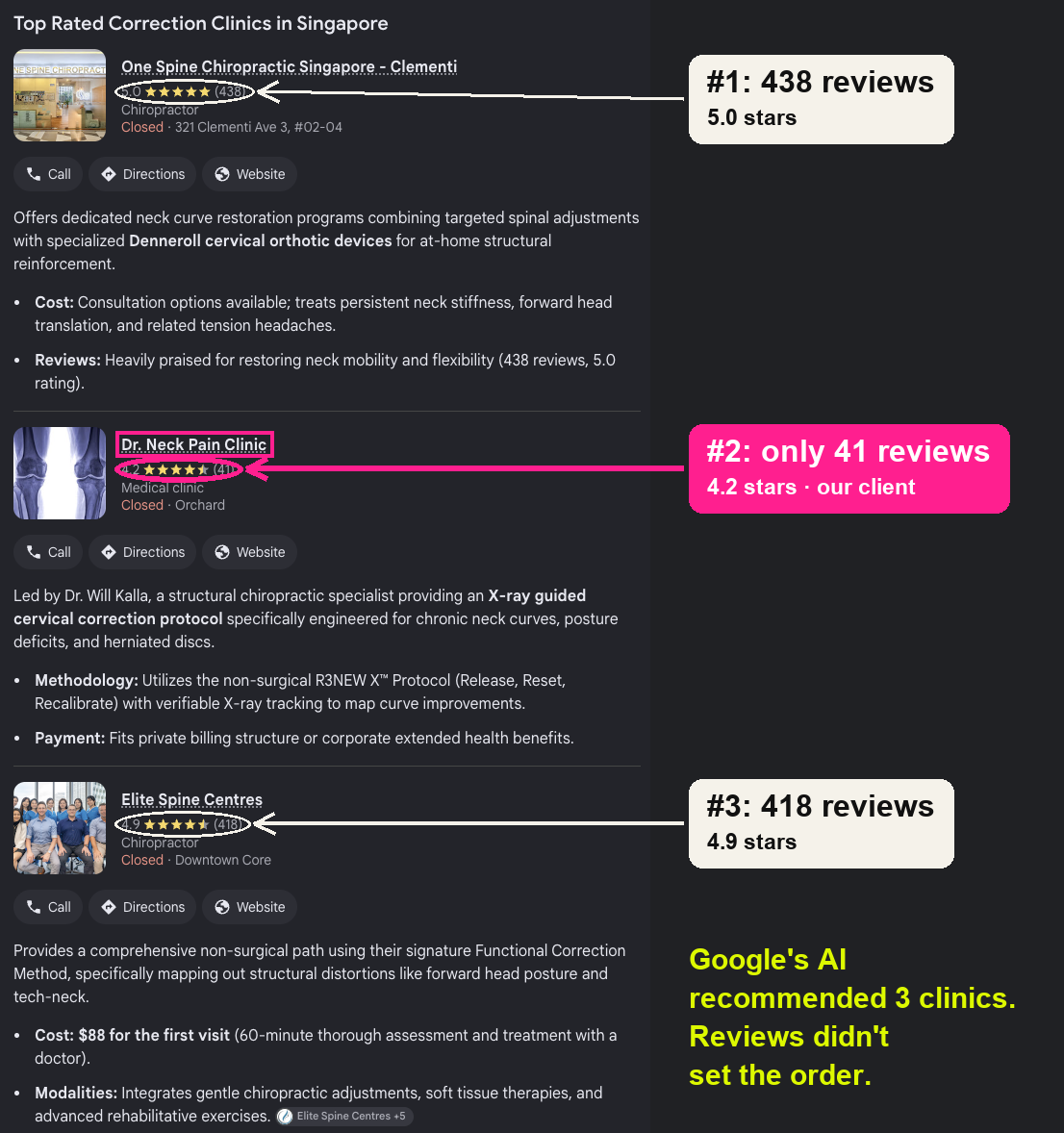
Google, Singapore, private window, 3 November 2026, 10:01pm: the three clinics Google’s AI recommended for a non-surgical neck curvature correction specialist. Markings are ours.
A one-person toy store up against LEGO and Fisher-Price. One of our overseas case studies is a part-time online store selling sensory and learning toys to schools, daycares, and clinic waiting rooms. She could never outspend the big brands. From August 2025, we published her expertise every month, in the formats and places her buyers already use. By June 2026, when ChatGPT was asked where to buy LEGO tables for dental offices, it named her store the best healthcare-focused retailer. She reports $730,000 in revenue for 2025, and in June 2026 she told us her revenue was up 43% on the year before.
Customers can only choose what they’ve seen, and they trust what they’ve heard about from others.
Neither business won by claiming to be better. Each won by answering real questions and getting those answers published where people and AI look.
Want to know which questions bring up your competitor’s name and not yours? We’ll check for free.
Run My Free ChatGPT Check ↗Where do customers choose your competitor over you?
The fix depends on which moment you’re losing at. Four quick questions will tell you.
Interactive
Where are you losing?
What to do with one hour a week
You don’t need a big budget to start closing the gap. You need a habit. Here’s how I’d spend one hour a week on the part only you can do.
- Pick one question a buyer asks right before they book.Take it from your calls, your WhatsApp messages, or the questions Google suggests. “How many sessions will I need?” beats “neck pain tips”.
- Record your answer.Spend most of the hour on a voice note or a phone video, answering it the way you would to a customer in front of you. Use your own examples, say what’s included and what it costs, and say who it isn’t for.
- Turn it into a page AI can quote.Make the buyer’s exact question the heading, give the direct answer in the first sentence, and use the rest of the page for the reasons and the proof.
- Share it where buyers look.A short video, a LinkedIn post, a Medium story, a podcast episode. Doing this well in several formats takes more than an hour, and that’s where a team or a system helps. Which formats work best is covered in the content ChatGPT quotes most.
- Fix one fact that doesn’t match.An old address on a directory, last year’s prices in an FAQ, hours that differ on Facebook.
- Do it again next week.Every answer stays up and helps the next one. A paid ad stops working the day the budget stops.
If you’d rather have it done for you, that’s what our service to get you recommended by ChatGPT does every month. For the do-it-yourself route, how to get your business mentioned in ChatGPT has the steps.
What to stop doing
Some of the most popular fixes on the market don’t work the way they’re sold. Drop these first.
- Buying hundreds of AI-written blog posts a month. I’ve tested many of these tools myself. What they produce is very generic and rarely helpful, and Google often removes it from search results or treats it as spam. AI tools look for something they haven’t already read a hundred times, like first-hand experience, real prices, and your own examples. A mass-produced post repeats what’s already out there, so it gives them nothing new to quote.
- Paying monthly for an llms.txt file. It’s a small text file, not a strategy. We explain why in does schema markup help AI search.
- Automated backlinks and mentions bought in bulk. Links still help, but fewer and better ones. A mention counts on a site with real readers, and being known can’t be bought by the batch.
- Arguing about acronyms. GEO, AEO, AI SEO: the label doesn’t matter. Being talked about does.
Questions owners ask
A fake listing is ranking above me. What can I do?
Report it to Google, then keep building your own name. Open the listing in Google Maps, choose “Suggest an edit”, and report it as spam or a place that doesn’t exist. Removal can take time, and it won’t make you better known, so keep publishing while you wait.
Why is my competitor ranking higher with worse reviews?
Because reviews are only part of what Google weighs. Google also looks at how close each business is to the person searching and how well known it is across the web. A rival nearer the searcher, or mentioned in more places, can sit above a business with better reviews.
Is there a tool that will get me ranked higher on Google Maps?
No tool does it for you. Tools can show where you rank and remind you to post, but none of them can make other websites and people talk about you. Be careful with forum replies that push one product; many of them are written by the people selling it.
My business is new. Is that why competitors show up first?
Partly, yes. A new business has very little written about it, so Google and AI have less to go on. Google takes months to trust a new site, and the clock only starts once you publish, so start now.
Would Google Ads fix this?
Ads buy you the top spot on Google while you pay. They don’t change what AI assistants say about you, and they don’t get your name mentioned anywhere else. They’re a tap you have to keep running, while published answers keep working after you stop.
Do Google reviews still matter?
Yes, for Maps and for the comparison moment. Google counts reviews when it decides how well known you are, and customers read them before they book. They just aren’t enough on their own to get AI to recommend you.
How long before customers start choosing us?
A single good page can be picked up within days. Becoming the name AI reaches for takes months. One of our client’s articles became Google’s top source for its question about two hours after it went live. The toy store above took around ten months of steady publishing to be named over much bigger brands.
Stop letting customers choose a competitor who isn’t better.
On a short call, we’ll show you where your rival gets mentioned and you don’t, and what we’d do first.
Book a Call ↗References
- Google Business Profile Help. “Tips to improve your local ranking on Google.” support.google.com
The owner stories are public forum posts by people describing their own businesses, paraphrased; their details are not verified. The toy store figures are the owner’s own reported numbers. AI answers change often, and results vary by business and market.