Written for owners of Singapore businesses that depend on being found: shops, clinics, studios, trades and service companies. No coding, no jargon.
Key takeaways
- ChatGPT knows a business in two ways. From what it learned before, and from what it finds when it searches. Most local businesses are missing from both.
- It names businesses that others describe clearly and the same way. Pick one sentence about what you do and where, then get it repeated.
- Get onto the pages it already reads for your category. In healthcare, more than half of AI citations came from listings and directories.
- Being written about beats links. Across 75,000 brands, mentions tracked visibility in Google’s AI answers about three times more closely than backlinks.
- Wikipedia, schema and “AI files” are not where a local business wins. Other sites talking about you, every month, is.
- Count it. Ask the same questions every month and write down who gets named.
How ChatGPT decides to mention a business
ChatGPT doesn’t rank businesses the way Google does. It writes an answer, and it drops in the names it is confident about. That confidence comes from two places.
- What it already learnedChatGPT was trained on a huge amount of the public internet. If your business was written about clearly and often, it may know you without searching at all.
- What it finds when it searchesFor questions like “best facial clinic in Tanjong Pagar”, ChatGPT often searches the web, reads a few pages, and names the businesses those pages agree on.
If you have never been named at all, start with why your business isn’t showing up in search, which separates being invisible from simply ranking low. Most local businesses are thin in both. There is too little written about them for ChatGPT to remember, and too few other pages to find. So it names someone else. SOCi’s 2026 study of more than 350,000 US business locations found ChatGPT recommended just 1.2% of them. Google’s map results showed 35.9%.
Test both in five minutes
You can see which side you are missing from right now. Open ChatGPT in a temporary chat, or logged out, so it doesn’t answer from your own history.
Ask ChatGPT this yourself
Without searching the web, what do you know about [your business name] in Singapore?Best [your service] in [your area]?Who should I see for [the problem you solve] in Singapore?Is [your business name] any good?
If the first answer is vague or wrong, ChatGPT hasn’t learned about you yet. If the next two name competitors, the pages it searches don’t mention you. The last one shows what people say about you, or that nobody says anything.
Keep the questions short. In a 2026 study by Semrush and Kevin Indig, short, casual questions got a brand named in nearly every answer. Long, detailed prompts got one named in 2% to 3%. Your customers type short questions, so test with those.
Step 1: One sentence everyone repeats
ChatGPT is careful about naming a business it can’t place. If one site calls you a “beauty salon”, another a “spa”, and your own site says “holistic wellness destination”, it isn’t sure what you are. So it picks someone it is sure about.
The fix is one plain sentence: what you do and where you do it. For example, “a Tampines clinic that treats acne scars with laser” or “a Tiong Bahru salon for curly and textured hair”. Then use the same words everywhere: your website, Google profile, directories, social bios, and every article written about you.
What this looks like in practice
Here is the same made-up clinic, described the way most are described today, and described so an AI can place it.
✗ Before: four different businesses
- Website: “Your journey to radiance starts here.”
- Google profile: “Beauty & wellness centre”
- Directory: “Glow Aesthetics Pte Ltd, medical spa”
- Instagram: “Glow SG 💖 skin, brows, lashes”
- Old listing: a Bugis address from two moves ago
✓ After: one business, one sentence
- Everywhere: “Glow Aesthetics, a doctor-led clinic in Tampines for acne scars and pigmentation.”
- Plus, on every listing: same name, same address, same hours
- On the site: who each treatment suits, who it doesn’t, what the first visit involves
Nothing in the second column is clever writing. It is the same facts, said the same way in every place a customer or an AI might look.
Say who it’s not for, too
This is the part almost everyone skips. A page that says who a treatment suits and who it doesn’t is easier for the AI to trust and quote. It also stops ChatGPT sending you the wrong customers.
✓ Easy for AI to place
- “For adults with acne scars, in Tampines”
- “Not suitable during pregnancy”
- “First visit: skin check and a plan, 45 minutes”
- Same name, address and phone everywhere
✗ Hard for AI to place
- “Your journey to radiance starts here”
- Three different business names across listings
- Services only listed in an image
- An old address still on a directory
Writing that sentence when you are a clinic
Singapore’s rules are stricter than most owners think, and they cover anything you publish or pay for. Here is the difference in practice, using the same clinic.
✓ Facts you can state
- “A doctor-led clinic in Tampines for acne scars and pigmentation.”
- “Treatments are carried out by doctors registered with the Singapore Medical Council.”
- “First visit: skin assessment and a plan, 45 minutes.”
- “Not suitable during pregnancy.”
✗ What the rules don’t allow
- “Singapore’s best acne scar clinic” (laudatory words)
- “Better results than other clinics” (comparing yourself with others)
- “98% of patients see clear skin in 6 weeks” (can’t be backed up)
- Patient reviews, testimonials, and before-and-after photos
If you hold a healthcare licence
The Healthcare Services (Advertisement) Regulations 2021 apply to aesthetic and medical clinics, dental clinics and hospitals. Everything you advertise must be factual and able to be backed up. Laudatory words, comparisons with other providers, reviews and testimonials, and before-and-after photos are all out. MOH publishes the word list in its FAQ. A breach can bring a fine of up to $20,000. This post is not legal advice, and your own compliance check has the last word.
If you are not licensed: physio, chiro, TCM, salons
Physiotherapy, chiropractic, TCM and psychology practices are not licensed under the same rules, and neither are salons. One rule still catches everyone. Since June 2023, nobody may advertise a skill or service for treating an ailment or condition in order to bring in patients. MOH’s own example: a chiropractic clinic saying it is “experienced in treating scoliosis” crosses the line, while offering “chiropractic service for back pain” does not. Say what you do, not what you cure.
What if you have several outlets?
Common in Singapore, and it changes one thing: the AI is asked about a place, not just a business. “Aesthetic clinic near Novena” and “near Tampines” are two different questions with two different answers.
So give each outlet its own page and its own listing, with the district in the sentence: “our Novena clinic, for acne scars and pigmentation”. Keep the company sentence identical across all of them, and change only the location and the opening hours. One address on one page. A single “Locations” page listing five branches gives the AI nothing to hold on to for any of them.
Step 2: Find the pages ChatGPT already trusts
Every category has a set of pages ChatGPT keeps going back to: certain directories, review sites, local guides and news sites. We went through which kinds of page it quotes, and which get your name said in a separate post. Being named on those is worth more than anything you publish about yourself.
Finding them is simple. Ask ChatGPT ten to twenty questions your customers ask, with search on. Write down which websites it links to. After a few rounds, the same names keep appearing.
In health, directories matter most
Yext looked at 6.8 million AI citations. In healthcare, 52.6% came from listings and directories. ChatGPT in particular took 48.7% of its citations from listings. BrightLocal found that for searches like “best chiropractor” and “best day spa”, ChatGPT leaned harder on directories than for other local searches.
So the first job is dull and important: be listed on the directories that come up for your category, with the same sentence, name, address and hours on every one.
Said plainly
ChatGPT trusts what other sites say about you more than what you say about yourself. Your job is to get onto the sites it already listens to.
Step 3: Get written about on sites it trusts
This is the step that moves the answer. It is also the one owners find hardest to do alone, because it means other websites writing about you.
The research backs this up. Ahrefs studied 75,000 brands. How often a brand was mentioned across the web tracked its visibility in Google’s AI answers with a correlation of 0.664. The number of backlinks scored 0.218. In a later study across ChatGPT and Google’s AI, mentions on YouTube tracked most closely of all, at 0.737. These show a link, not proof of cause, but the direction is clear: being talked about matters more than being linked to.
Four places a local business can be mentioned
Not every mention is equal. These are the ones that tend to feed AI answers, from easiest to hardest to get.
- Articles, videos and podcasts about what you doPublished on well-known platforms such as Google News, YouTube, Spotify, Apple Podcasts, LinkedIn and Medium, each repeating your one sentence.
- Other people’s guides and “how to choose” listsLocal roundups and comparison pages that name several providers, yours among them.
- Established news sitesThe kind ChatGPT and Google already treat as trustworthy. One article there carries more weight than dozens on unknown blogs.
- Expert quotesYour practitioner quoted as the person who knows, in an article someone else wrote.
Clinics: the part nobody tells you
If you pay for or ask for an article about your licensed clinic, MOH treats it as your own advertising, so the same rules apply to every word in it. A roundup you didn’t ask for is a different thing, and you are not responsible for it. But you may not pay for a place in one, reshare it, or link to it, and if it carries praise or ranks clinics you may be expected to ask for it to be taken down. Plain directory listings, which show contact details and list everyone in order, sit outside the advertising rules. Talk to us about which of this fits your licence before we publish anything.
Doing it yourself vs having it done
You can pitch journalists and chase guest posts yourself. It works, slowly. Here is how that compares with the two services we built for exactly this step.
| What it takes | Doing it yourself | MultiCasting | Featured. |
|---|---|---|---|
| Where you appear | Wherever a pitch lands | Hundreds of sites: news, video, podcasts, slides | Sites such as USA Today, Business Insider, Medium and the Associated Press |
| Who writes it | You | We do | We do |
| Is it published? | Only if an editor says yes | Yes, every month | Yes, placement is guaranteed |
| Your time | Hours a week, for months | Approving topics | Approving the article |
MultiCasting turns the one thing you want to be known for into articles, videos, podcasts and slideshows, published in many places every month. Featured. puts an article about your business on the news sites AI already trusts. They work best together: one gives you volume, the other gives you weight. For a licensed clinic, everything we publish is written to your rules and approved by you first, because in MOH’s eyes it counts as your advertising. What nobody can guarantee, including us, is the AI’s answer itself. What we guarantee is that the pages it reads start talking about you.
Step 4: Reviews and real conversations
When ChatGPT is about to name a business, it checks what people say about it. In SOCi’s study, the locations ChatGPT recommended averaged 4.3 stars. A weak or thin review profile can keep you off the list even when everything else is right.
Reviews that mention what the customer came in for help most, because they repeat your one sentence in someone else’s words. Ranked., our Google Maps service, includes a steady system for getting them. For a licensed clinic, check your advertising rules before you ask patients for reviews or reuse them.
What about Reddit?
Discovered Labs found ChatGPT pulls Reddit in mostly for opinion questions, like “is it worth it?” or “what do people think of…”. For plain “best” questions it rarely does. If people in your field talk on a forum, answer questions there honestly and as yourself. Never post fake reviews or planted comments. They get spotted, and they can cost a clinic far more than they gain.
What you can skip
A lot of advice on this topic comes from people who work with software companies and national brands. Some of it doesn’t apply to a clinic or salon at all.
- A Wikipedia page. Wikipedia only accepts companies that independent sources have written about in depth. Most local businesses don’t qualify, and pages that don’t meet the rules get deleted.
- Wikidata entries and “entity” work. Useful for big brands. For a local business, being written about on real sites does the same job and brings customers too.
- Documents for companies’ private AI tools. That matters if you sell to big companies. Your customers are people asking ChatGPT on their phones.
- Schema, llms.txt and technical audits as the main plan. Fine to have. Not what gets a business named.
What we do differently
Here is what we saw for Dr Neck Pain, a chiropractic clinic in Singapore, when we did this work for them from early September 2026.
How we know
We started by asking, not by fixing. A week into the work we asked five AI assistants, including ChatGPT, 34 questions patients ask. The clinic was named in about one answer in ten. On more than half of the questions, a competitor was named and the clinic wasn’t. That is what we measure against every month.
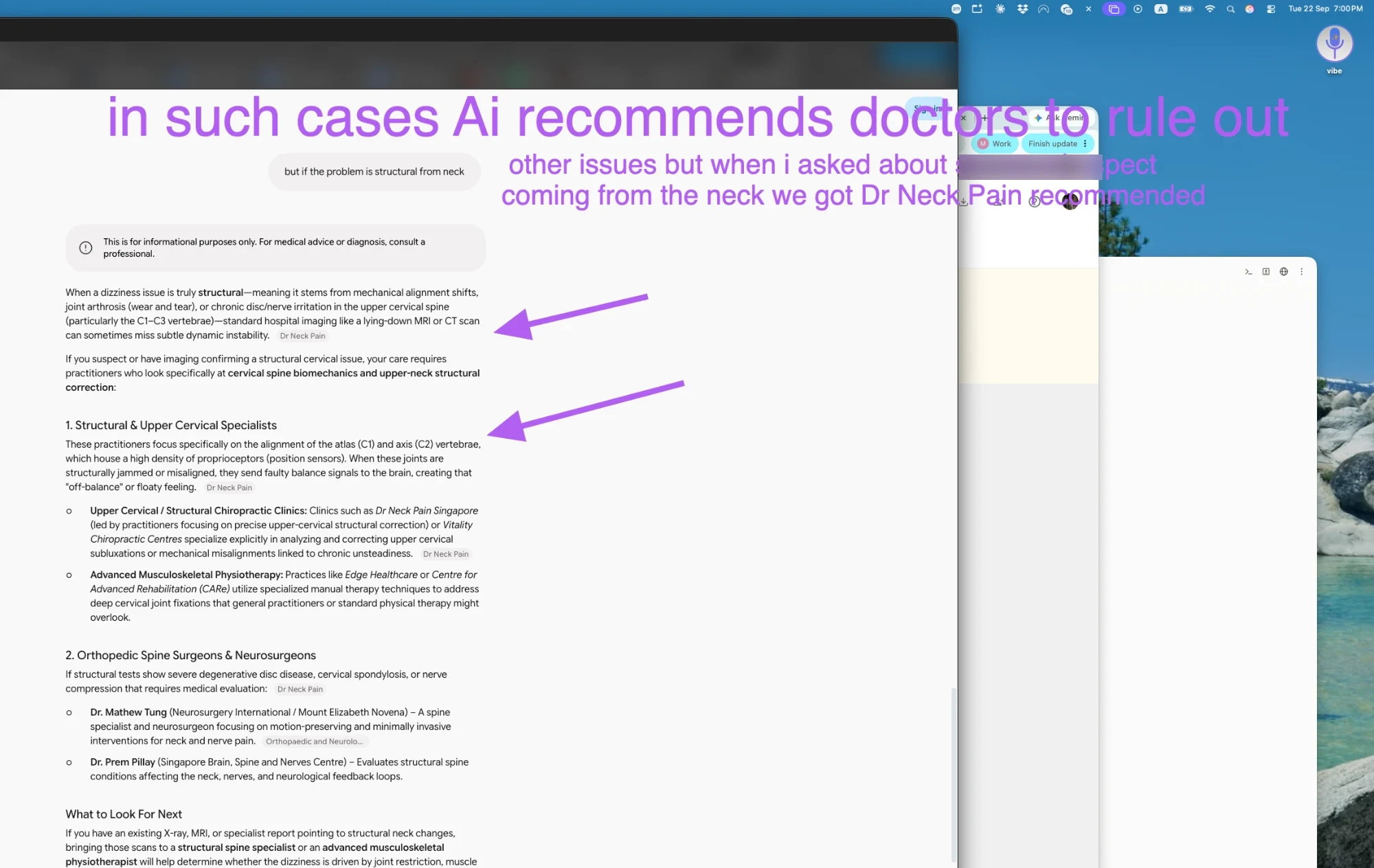
Then the answers started to change. On 17 September we searched “the best neck pain specialist” in a private window. Google’s AI Overview listed Dr Neck Pain Clinic second in its top options, above a medical pain clinic and a private hospital group. On 22 September, the answer at the top of this post named the clinic first for dizziness coming from the neck.
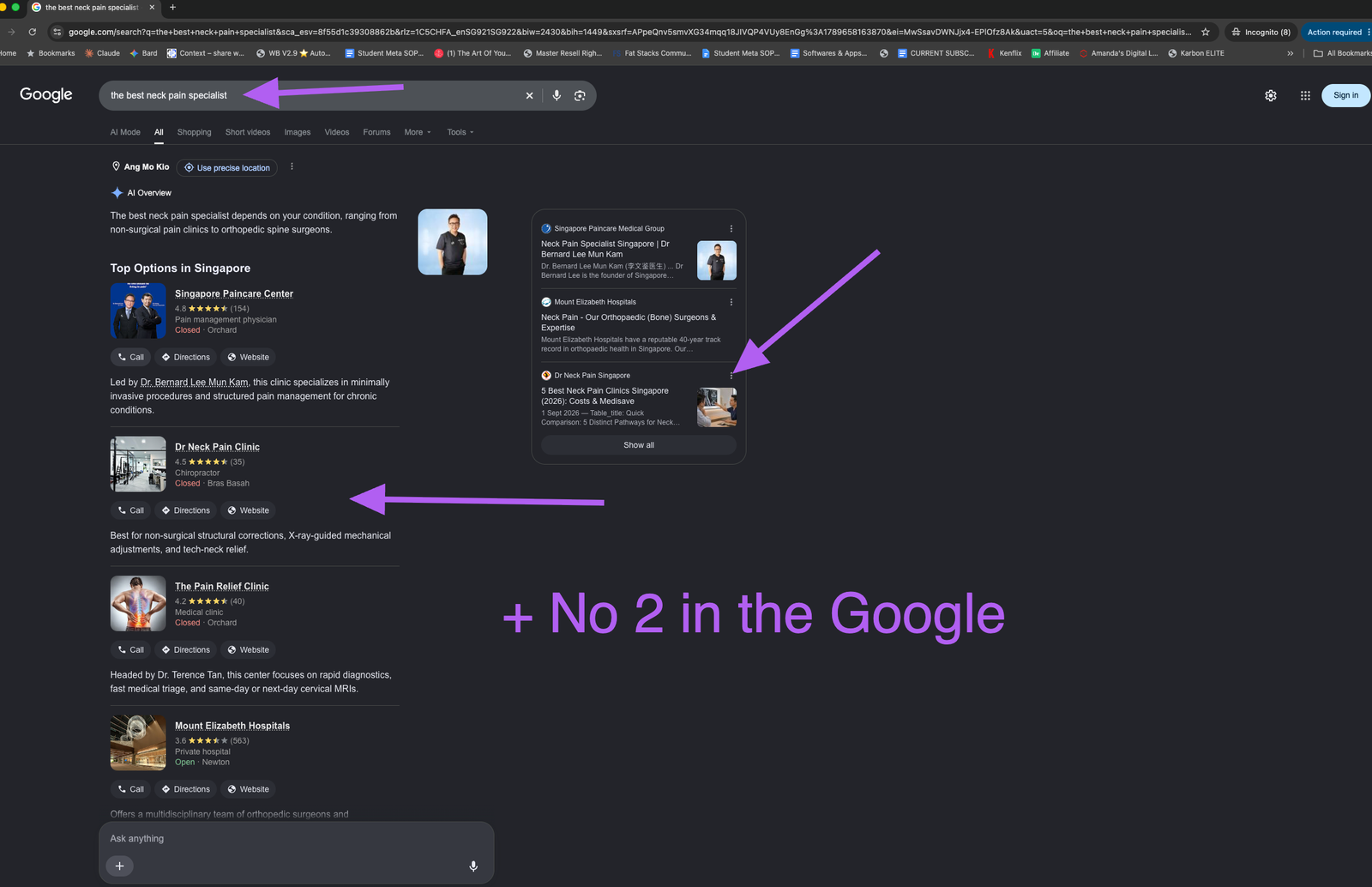
Google search, Singapore, private window, 17 September 2026. Purple arrows mark the clinic in the AI’s list and in the sources.
People started searching for the name. Google’s “People also search for” box now shows “Dr neck pain reviews”. That tends to appear once people start looking a business up by name.
It isn’t a big website. Semrush gives it an Authority Score of 9 out of 100. Hospitals with far stronger websites sit below it in these answers.
To be fair about it: the dated screenshots are Google’s AI, which we can check signed out. AI answers change from day to day, and one answer is not a fixed position. That is why we ask the same questions again every month.
How our approach compares
Most “AI visibility” work on offer starts in a different place from ours. Here is the difference, side by side.
| What matters | The usual approach | How we do it |
|---|---|---|
| Where it starts | A technical audit of your website | Asking ChatGPT, Gemini, Perplexity and Google your customers’ questions, and writing down who they name |
| Where it publishes | Your own blog | Your site, plus hundreds of other sites and trusted news sites |
| What you get told | Rankings and traffic charts | Who the AI names for each question, this month against last month |
| Reviews and Maps | Someone else’s job | Under the same roof, if the audit shows they’re holding you back |
| Who does the work | You get a to-do list | We do it. You approve topics. |
Which gap is yours?
Not sure which of these you need first? Four questions will tell you.
Interactive
What’s stopping ChatGPT from naming you?
Want to see who ChatGPT names instead of you? We ask the questions your customers ask and show you every answer.
Get My Free Audit ↗Questions owners ask
How do I get my business mentioned in ChatGPT?
Be described clearly, and be described by others. Pick one sentence about what you do and where. Get listed on the directories ChatGPT uses for your category. Then get articles, videos and news pieces about you published on sites it trusts, every month. Ask the same questions monthly to see if it’s working.
Can I pay ChatGPT to feature my business?
No. There is no way to buy a place in its answers. It names businesses based on what it has learned and what it finds. Anyone who promises “guaranteed #1 in ChatGPT” is promising something nobody controls.
How long does it take?
Some answers move within days, others take months. Google’s AI named our client within two weeks of starting. What ChatGPT has learned changes more slowly than what it finds by searching, which is why the work runs monthly, not once.
Why does ChatGPT get my business details wrong?
Usually because the internet has them wrong. An old address on a directory, a different name on Facebook, services listed only in a picture. Fix the listings, keep one sentence everywhere, and give it fresh pages with the right facts.
I run a medical clinic. Is this allowed?
Yes, done carefully, and you stay in control. What we publish is educational and factual: what a treatment is, who it suits and what to expect. No before-and-after photos, no “best clinic” claims, and no patient stories about results. You approve every topic, and your own compliance check always has the last word.
We have outlets in several districts. Do we do this once or five times?
Once for the business, then once per outlet. Keep one sentence for the company, and give every branch its own page and its own listing with its district, address and hours. People ask AI for a place near them, so each outlet has to exist on its own.
Do I need a Wikipedia page?
No. Most local businesses don’t meet Wikipedia’s rules for a page, and it isn’t needed. Being written about on real, trusted sites does the job.
Get your name in the answer.
A short call. We look at your audit together and decide what to fix first: Maps, press or publishing.
Book a Call ↗References
- SOCi. 2026 Local Visibility Index. 28 January 2026. soci.ai
- Semrush, Margarita Loktionova, with Kevin Indig. Why 62% of AI citations don’t lead to brand mentions. 9 June 2026. semrush.com
- Yext. AI citations research. 9 October 2025. yext.com
- BrightLocal, Sammy Paget. Uncovering ChatGPT search sources. 12 December 2024. brightlocal.com
- Ahrefs, Louise Linehan and Xibeijia Guan. An analysis of AI Overview brand visibility factors (75K brands). 26 May 2025. ahrefs.com
- Ahrefs, Louise Linehan and Xibeijia Guan. Top brand visibility factors in ChatGPT, AI Mode and AI Overviews. 12 December 2025. ahrefs.com
- Discovered Labs, Liam Dunne. How ChatGPT retrieves in 2026. Updated 6 September 2026. discoveredlabs.com
- Wikipedia. Notability (organizations and companies). en.wikipedia.org
- OpenAI. ChatGPT search. Help Center. help.openai.com
- Singapore Statutes Online. Healthcare Services (Advertisement) Regulations 2021. sso.agc.gov.sg
- Ministry of Health. Regulation of advertisements for aesthetic treatments. 9 January 2024. moh.gov.sg
- Ministry of Health. FAQs on the Healthcare Services (Advertisement) Regulations, version 1.1, updated November 2024. moh.gov.sg (PDF)
- Singapore Statutes Online. Healthcare Services Act 2020, section 31A (advertising treatment of an ailment), in force 26 June 2023. sso.agc.gov.sg
Most studies cited here measured US or global data, not Singapore businesses, and each used its own method. Treat the figures as direction, not guarantees. AI tools change their sources without notice. Nothing in this post is legal advice on healthcare advertising.