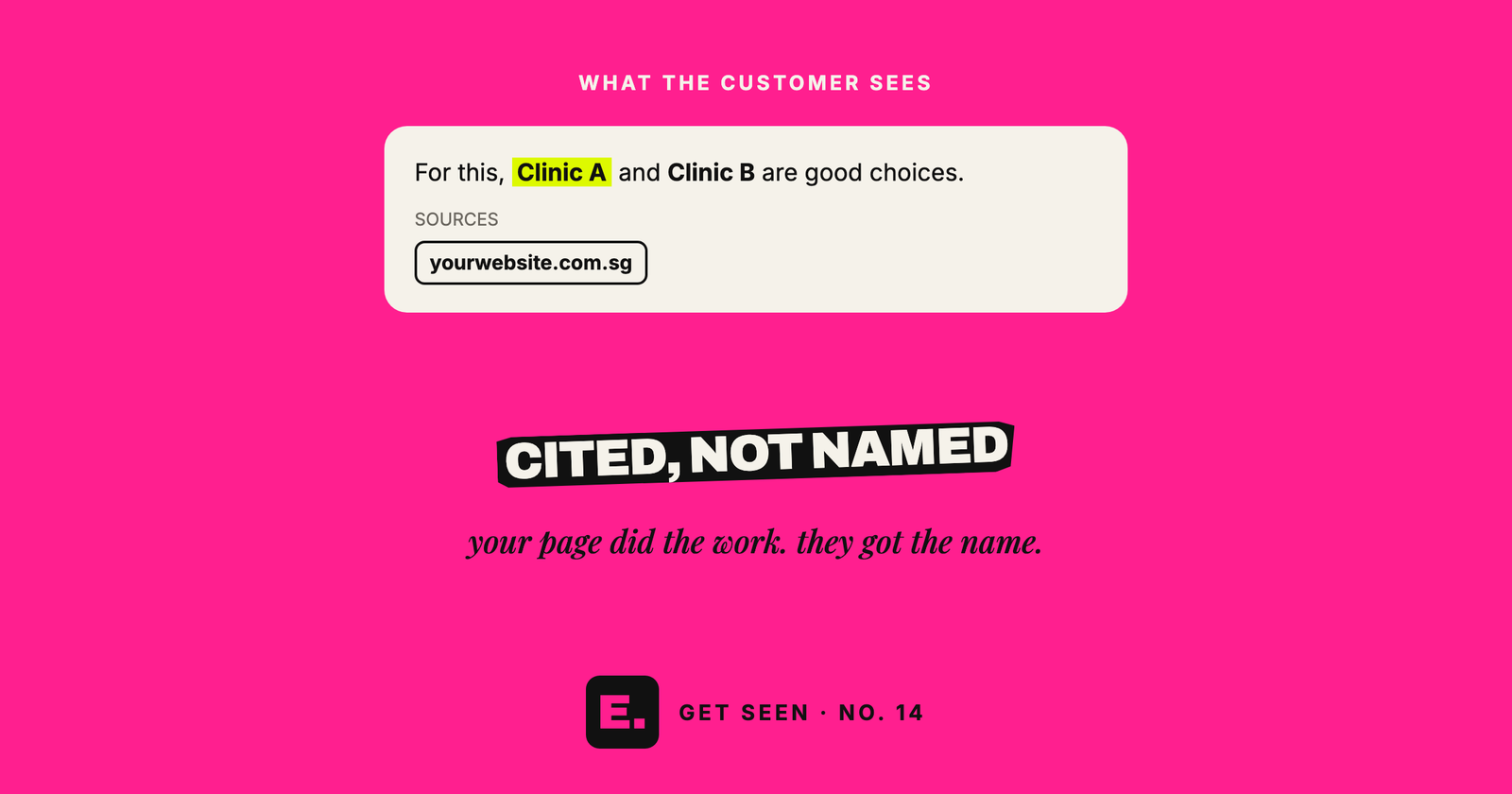
For the owner who asked ChatGPT about their own business, saw it come up, and wants to know what ChatGPT brand mentions are really worth.
The short answer
A ChatGPT brand mention is when ChatGPT says your business's name in its answer. A citation is different: it's a link to a web page, shown as a source. You can get one without the other.
Mentions matter because people act on the names in the answer, not on the links underneath it. For SEO, that means tracking whether you're named, alongside your Google rankings.
Read this first: we sell work that gets businesses named. The clinic in our examples is one we publish for, and we show its results with its permission.
Key takeaways
- Being cited isn't being named. In a 2026 Semrush study of 1,094 ChatGPT topics, the most-cited website was also the most-named brand in only 21% of them.
- The name is what people act on. Research reported in the same study found 74% of users picked the brand named first in the answer.
- One question tells you almost nothing. In 53.7% of topics, no brand showed up in even three of five similar questions.
- Stay close to what you're known for. ChatGPT named brands in 44% of their appearances on topics near their expertise, and 25% on distant ones.
- A bigger website barely helped. The brand that owned a topic had the higher authority score in only about half the cases.
- The way you ask changes the winner. In one test, the brand named first in a comparison question won 54.7% of the time.
- A drop can be the AI changing, not you. Articles on news and review sites fell from 45.2% to 22.5% of ChatGPT's sources in one shopping dataset between July and September 2026.
What ChatGPT brand mentions are
ChatGPT brand mentions are the times ChatGPT names your business, product or service in an answer. It might recommend you, list you next to competitors, or name you in passing. The customer never has to click anything to see it.
That last part is why this matters to a local business. Someone in Singapore asks ChatGPT “which clinic should I see for neck pain?” or “who does good balayage in Tiong Bahru?”. The answer names two or three places. If yours isn't one of them, you weren't in the running, and you'll never find out that it happened.
Said plainly
A mention is ChatGPT saying your name to a customer. It's the new word of mouth, and you can't hear it unless you go and check.
ChatGPT brand mentions, citations and recommendations are three different things
People mix these up, and the difference decides what you measure. Here is what each one looks like in a typical answer.
An example answer, made up to show the parts
“Which physio clinic should I see for a running injury in Singapore?”
For running injuries, Clinic A is a strong choice because it runs gait analysis on site. Clinic B and Clinic C also treat sports injuries. Sources: Clinic D's website, a forum thread
- Recommendation: Clinic A is named and picked, with a reason.
- Mention: Clinic B and Clinic C are named, but not picked.
- Citation: Clinic D's website is linked as a source, yet Clinic D is never named in the answer.
Clinic D did the work. Its page gave ChatGPT something to read. But the customer walks away with three other names. Semrush calls this a ghost citation, and we looked at how common it is in the kinds of content ChatGPT quotes and the kind that gets you named.
A mention on another website is different again. A review or news piece that names you is a web mention. It only becomes a ChatGPT mention when ChatGPT repeats your name in an answer.
This isn't only a small-business problem. In Semrush's AI Visibility Index for July 2026, Ford was the 18th most-mentioned brand in ChatGPT answers to US car questions. Ford's own website ranked 1,055th among the sources ChatGPT cited. On average, fewer than half of the 100 brands AI names most also appear among the 100 websites it cites most. Other people's pages are doing the talking about Ford, and ChatGPT reads those.
Why the name matters more than the link
Most SEO reports count links and rankings. ChatGPT changes what counts, because the customer reads the answer and often stops there.
In 2026, Semrush and the researcher Kevin Indig tracked 1,094 topics in ChatGPT from January to June. In only 21% of those topics was the most-cited website also the most-named brand. The site ChatGPT reads most is usually not the business it names.
The same study reports earlier research by Kevin Indig's Growth Memo, in which 74% of users picked the brand the answer named first. People act on what the answer says.
Rankings tell you who gets read. Mentions tell you who gets chosen.
Keep tracking your Google rankings. Add a second question to your monthly check: does ChatGPT say our name when customers ask?
There's no evidence that a ChatGPT mention changes your Google ranking directly. Its value is simpler: a customer heard your name at the moment they were choosing.
Why one question tells you nothing
Many owners test this once. They type “best [my service] in Singapore” into ChatGPT, see a list, and draw a conclusion. The Semrush data shows why that misleads.
- Only 15.2% of topics had a clear owner.That meant one brand appearing in at least four of five similar questions, with a clear lead over the next.
- In 53.7% of topics, nobody stuck.No brand appeared in even three of the five questions.
- The popular topics were the most open.Among the most-asked topics, only 11.3% had a clear owner.
- Answers also change between runs.We've seen the same question give a different list of names a few days later.
So being named for one question, once, proves little. Missing from one proves little too. What counts is how often you're named across all the questions your customers ask, checked more than once. The good news: in most topics the spot is still open.
The way you ask changes which brand ChatGPT mentions
In October 2026, two marketing agencies tested head-to-head questions like "Brand A or Brand B?" on OpenAI's model with live web search. They asked every pair both ways round, usually five times each, and kept 4,608 answers. The brand named first in the question won 54.7% of the time, when no order effect would give 50%. In about one matchup in six, swapping the order changed which brand won most often.
So if anyone shows you a score like "you win 60% of comparisons", ask to see the questions. If your name always came first, part of that win came from the question. The study used one model, mostly brands from the agencies' own clients, and both agencies sell this kind of work. The lesson still holds for any test you run: ask comparisons both ways round.
When ChatGPT brand mentions drop, it isn't always you
A company that tracks AI shopping answers looked at more than 38 million citations in its clients' dashboards from July to mid-September 2026. In July, articles on news and review sites made up 45.2% of the sources ChatGPT cited. By September, it was 22.5%. Brands' own websites went the other way, from 1.7% to 21.5%. Gemini moved in the opposite direction: articles on news and review sites rose from 35.5% to 51.9% of its sources.
| Sources ChatGPT cited | July 2026 | September 2026 |
|---|---|---|
| Articles on news and review sites | 45.2% | 22.5% |
| Brands' own websites | 1.7% | 21.5% |
| Retailer websites | 10.4% | 17.5% |
| Social and forum posts | 19.1% | 0.5% |
A business that relied on press articles could have lost ChatGPT citations in those weeks without anything changing on its side. So when your mentions fall, ask two questions: did we lose ground, or did the kind of source we rely on lose ground? The data leans toward shopping questions, and September covers only 14 days, so treat it as a warning, not a rule.
What gets you ChatGPT brand mentions
Two findings from the Semrush research point the same way, and they match what we see in our own work.
Stay close to what you're known for
Semrush looked at brands appearing in topics near their core expertise and in topics far from it. Near home, ChatGPT named brands in 44% of their appearances. Far from home, only 25%. Being linked as a source held up better (74% near, 50% far). The name sticks to what you're known for.
For a local business, that means picking one thing you want to be known for, and saying it the same way everywhere. A physio clinic that publishes about everything from diets to sleep apps gets read. One that answers every question about running injuries gets named.
A bigger website barely helped
When Semrush compared topic owners with the runners-up, the owner had the higher authority score in only 52.5% of pairs, close to a coin toss. The one difference that counted was how often people searched for the brand by name, and even that edge was modest.
People search for your name after they've heard it somewhere: a friend, a review, a news piece, a video. That's the same thing that gets ChatGPT to say it. We explain the practical side in how to get your business mentioned in ChatGPT, and why AI picks one name over another in how ChatGPT decides which brands to recommend.
Being talked about widely beats one big hit
Ahrefs looked at 75,000 brands and compared how often ChatGPT, Google's AI Mode and AI Overviews named each one. The number of YouTube videos that mentioned a brand lined up with AI visibility at 0.737. Weighting those videos by views gave 0.717. So many ordinary videos that mention you lined up slightly better than a few with huge audiences.
ChatGPT also looked less tied to the usual signs of a big brand. Its link to how often people search a brand's name was 0.352, and to a site's link strength 0.266. Google's AI Mode was more tied to them, at 0.466 for brand searches. Two cautions: the difference between the two YouTube numbers is small, and the study only covered larger, established websites. It shows a pattern, not a recipe. It does fit what we see: steady mentions in many places do more than one viral piece.
Answers to early questions lead to answers at the buying stage
An SEO agency's report from October 2026 covered 161 brands and about 16,500 AI answers from nine AI platforms. Of the brands AI cited in answers to research questions, it also named 94% in answers to buying questions. For brands it didn't cite at the research stage, the figure was 50%. The report calls this a link, not a cause.
For a clinic, a research question sounds like "why does my neck hurt after sitting all day?". A buying question sounds like "which neck pain clinic in Singapore should I see?". Being the source for the first kind and getting named for the second kind went together in this data. That is why we write for the early questions too, not only the "best clinic" ones.
ChatGPT brand mentions for a Singapore clinic
The Semrush data covers US topics. Here is what the same pattern looks like for a Singapore clinic.
How we know
On 8 September 2026, we ran our AI Search Audit for Dr Neck Pain, a chiropractic clinic in Singapore. We asked ChatGPT, Claude, Gemini, Perplexity and Google's AI the same 34 questions a patient asks, 170 answers in total.
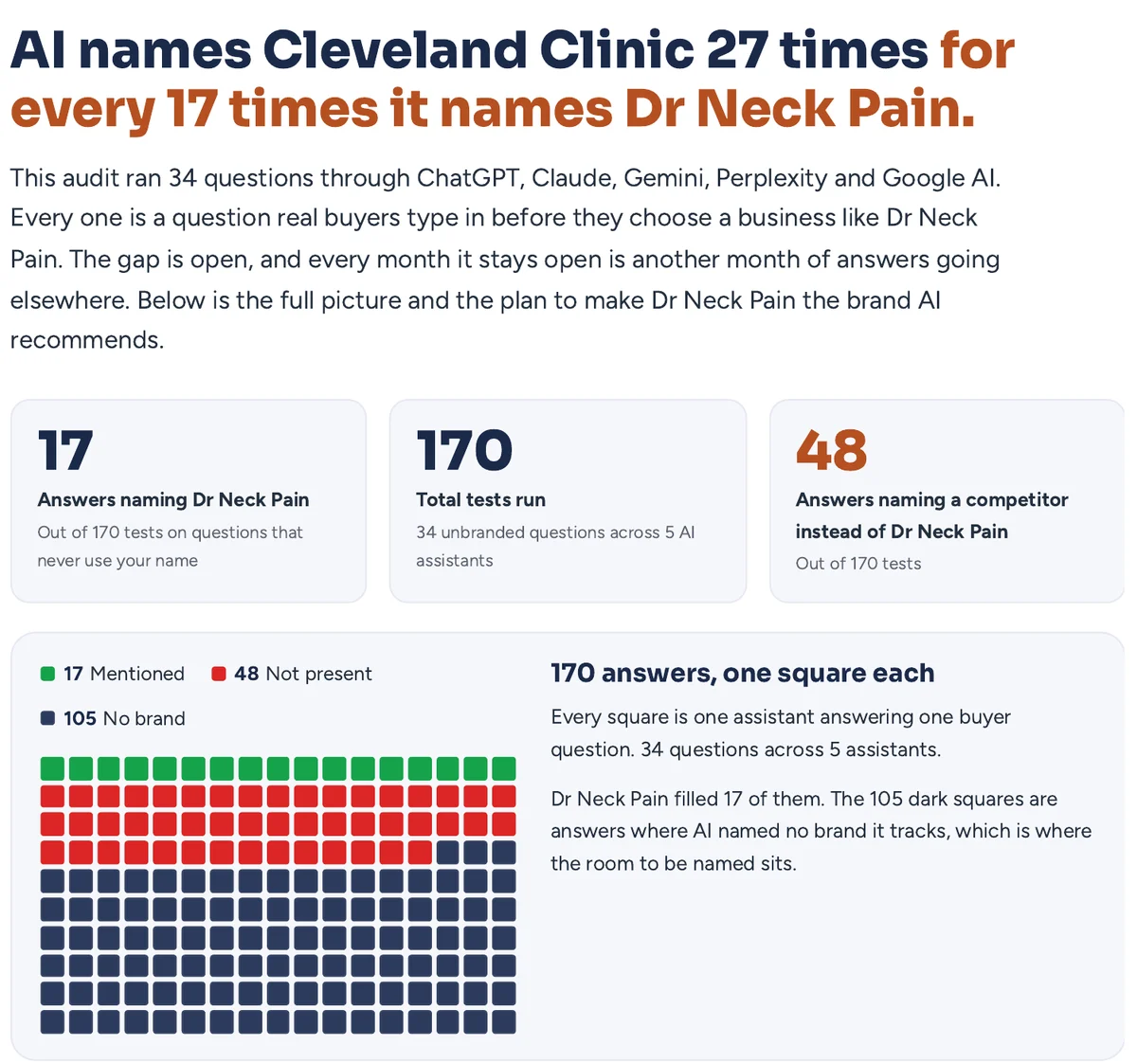
AI Search Audit, Dr Neck Pain, 8 September 2026. Taken a week into our work with the clinic, so it's a snapshot, not a before-and-after.
Every assistant knew the clinic. When we asked about Dr Neck Pain by name, all of them recognised it.
But the assistants named it in only 17 of 170 answers to patients' questions. Knowing your name and saying it to a customer are different things.
Most answers named nobody. 105 of the 170 answers didn't name any business at all. That matches the Semrush finding: in most topics, the spot is still open.
That gap between “knows you” and “names you” is what most owners miss. They ask ChatGPT about their own business, get a good description, and assume they're visible. The customer never asks about you by name. They ask about their problem. If you'd like to see what a full report looks like, here's our AI visibility audit, walked through page by page.
Five weeks later
On 10 October 2026 we ran the audit again. The assistants named the clinic in 26% of answers, up from 10% on a comparable audit five weeks earlier. In between, the clinic kept publishing guides and two of our MultiCasting campaigns went out. Most answers, 73%, still named no business at all, so there is still room.
The same work shows on Google. On 30 October 2026, we searched Google in a private window for "best neck pain specialist". The clinic's page came first in the ordinary results, below the map and above the National University Hospital. It was the only chiropractor in the unpaid results. That matters because chiropractors in Singapore aren't registered with MOH, and AI answers for this search lean on doctors and hospitals.
Do press releases get you ChatGPT brand mentions?
Press releases are sold more and more as an "AI visibility" tool. The best data so far comes from a company that runs a newswire. In October 2026, it published a study of 26,670 of its own English releases from June and July 2026. It tracked more than 850,000 AI citations of them.
| What the release had | AI citations, compared with an average release |
|---|---|
| Clear subheadings that say what each part is about | 61% more |
| Lots of facts: dates, places, numbers, names | 29% to 33% more |
| An FAQ section | No difference (−1.6%) |
Two more findings change how you check results. More than half of the ChatGPT and Claude citations, 56.4%, came more than a week after the release went out. And the typical first citation came 1.2 hours after publishing on ChatGPT, but 46 hours on Claude. Checking once, the morning after, misses most of it. The study also found AI systems often keep citing the version they read first. So get the facts right before you publish, not in a correction.
The study's own words matter here: these are links, not proof of cause. A company that sells distribution ran it, and it counted citations, not whether anyone was recommended, visited or booked.
What people who send releases say
In marketing forums this year, practitioners disagree. Some PR people say they regularly see wire releases cited in AI answers. Others say a release did little until a real publication wrote about it. One business owner described two months of releases, articles and directory listings, and AI still put the company in the wrong industry. The fix that commenters suggested was simple: describe the business the same way everywhere, on the website, LinkedIn, directories and every release.
How we see it
A press release is reference material. It can be cited as a source for a fact. That isn't the same as a journalist covering you, and neither is the same as ChatGPT recommending you to a customer. So we keep three questions apart. Did a real outlet write about it? Did an AI cite it? And does AI now name you when a customer asks without using your name?
That last question is the one that pays. It is why our publishing work, MultiCasting, puts each answer in many places every month: articles, news sites, video, audio and social posts. We write each one as plain facts under clear headings. Then the monthly audit checks whether AI names you. If it doesn't move, we change what we publish.
How to track your ChatGPT brand mentions
You don't need special software to start. You need the right questions and the patience to ask them more than once.
- Write down your customers' real questionsTwenty or thirty, in their words. Cover every stage, from “what is this pain?” to “which clinic should I choose?”. Never include your business name.
- Ask them in a logged-out chatUse a private window so ChatGPT doesn't answer from your own history.
- Record five things for each answerWere you named? Were you recommended or only listed? Was your website linked? Who was named instead? Was what it said about you correct, from your address to what you actually do?
- Ask comparisons both ways roundIf you test "you or a competitor?", also ask "the competitor or you?". The name that comes first tends to win, so one order alone flatters whoever is first.
- Repeat the same list every monthAnswers move, so one round proves little. The same questions each month show the direction.
- Check your analytics for ChatGPT visitsOpenAI says ChatGPT adds
utm_source=chatgpt.comto the links it sends people through. A mention without a link won't show up there, which is why step 3 matters.
Keep the counts apart: how often you're named, how often you're recommended, and how often your site is linked. They move differently, and a report that blends them hides the part that matters.
Not sure where you stand? Tick whatever sounds like you.
1-minute self-check
Does ChatGPT say your name?
Tick any that sound like you. A result appears as soon as one is true.
Your result will show here.
Want to see who ChatGPT names instead of you? Get My Free AI Visibility Audit ↗
Then you don't know yet, and that's fixable today
Our free audit asks five AI assistants the questions your customers ask, and shows where you're named and who is named instead.
That's a ghost citation
Your page is doing the work and someone else gets the name. The audit shows which answers use your site without naming you.
Then read which kinds of page get a business named, not just quoted.
They're being talked about more than you
ChatGPT repeats the names it sees across the web. The audit shows exactly who it names and for which questions.
See Who ChatGPT Names Instead ↗
MultiCasting, our publishing service, gets your name into the places AI reads, every month.
Known, but not named
That was the clinic in our audit: every assistant knew it, and they named it in 17 of 170 answers. The fix is answering your customers' questions better, in more places.
More than one, so start with the facts
Before you change anything, see what ChatGPT and four other assistants actually say about your business, question by question.
Questions owners ask
What is a ChatGPT brand mention?
It's when ChatGPT says your business's name in an answer, whether it recommends you, lists you with others, or names you in passing. A citation is different: a link to a web page shown as a source.
How do I track brand mentions in ChatGPT?
Ask ChatGPT your customers' real questions in a logged-out chat, and record who it names. Use the same list every month and ask more than once, because answers change. Record mentions, recommendations and links separately.
Do ChatGPT mentions help my Google SEO?
There's no evidence they change your Google ranking directly. They matter because customers hear your name while choosing. The same things that get you named, like being talked about in many places, also tend to help your search results.
Why does ChatGPT know my business but not recommend it?
Knowing a name and connecting it to a customer's problem are different. ChatGPT names the businesses the web links most clearly to that question. Answer your customers' questions on your own site, and get talked about elsewhere for the thing you want to be known for.
Do press releases help ChatGPT mention my business?
They can get cited as a source, which is not the same as being recommended. In one newswire's study, AI cited releases with clear subheadings and lots of facts more often, and an FAQ section made no difference. Whether ChatGPT names you to a customer depends on how widely you're talked about for that question, so check that separately.
Why did my ChatGPT mentions drop when I changed nothing?
The assistant may have changed which sources it reads. In one dataset, articles on news and review sites fell from 45.2% to 22.5% of ChatGPT's sources in a few weeks of 2026. Compare yourself with competitors on the same questions before deciding your work stopped working.
Can I see ChatGPT traffic in Google Analytics?
Yes, for clicks. OpenAI says ChatGPT adds utm_source=chatgpt.com to the links it sends. Mentions without a link won't show up, so you still need to check the answers themselves.
Find out if ChatGPT says your name.
We ask ChatGPT and four other AI assistants the questions your customers ask, and show you who gets named instead of you. Free, done by hand.
Get My Free AI Visibility Audit ↗References
- Semrush AI Visibility Index, July 2026, as reported by Robert Rose, Content Marketing Institute, 27 October 2026 (Ford: 18th most-mentioned brand, website 1,055th cited source). contentmarketinginstitute.com
- Brand position bias in AI comparisons, whitepaper v1.0 by two marketing agencies, October 2026. 4,608 votes, 482 matchups, OpenAI model with live web search, collected 8 to 16 October 2026. Brand sets mostly from client projects.
- Citation-mix analysis by an AI shopping-visibility company, 28 October 2026. More than 38 million citations from client dashboards, 1 July to 14 September 2026; weighted to shopping questions.
- Ahrefs. AI brand visibility correlations, 12 December 2025. 75,000 brands, sites above DR 40. ahrefs.com
- An SEO agency's Q3 2026 search report, announced 25 October 2026. 161 brands, about 16,500 AI answers from nine platforms; presented as a correlation.
- A newswire operator's study of 26,670 English press releases, June to July 2026, and more than 850,000 AI citation events, published 29 October 2026. Reports associations, not causes.
- Marketing forum threads on press releases and AI visibility, 2026, read 30 October 2026. Practitioners' opinions; no commenter or service named here.
- Get Brand Exposure. AI Search Audit for Dr Neck Pain, 34 questions across five AI assistants, 10 October 2026. Google search, Singapore, private window, 30 October 2026.
- Semrush with Kevin Indig and Growth Memo. ChatGPT topic authority study: 1,094 US categories, tracked monthly in ChatGPT, January to June 2026. semrush.com
- Semrush with Kevin Indig and Growth Memo. ChatGPT topical focus study: citations and mentions near and far from a brand's core expertise, 2026. semrush.com
- OpenAI Help Center. Publishers and Developers FAQ (utm_source=chatgpt.com in referral links; OAI-SearchBot access). Checked 27 September 2026. help.openai.com
- Get Brand Exposure. AI Search Audit for Dr Neck Pain, 34 questions across five AI assistants, 8 September 2026.
AI answers change often, and the same question can get different answers on different days. The Semrush data covers US topics. This post reflects the studies cited and our own audits as of 30 October 2026.