For the owner with an SEO proposal in their inbox, wondering whether hiring an SEO agency in Singapore will finally bring in the customers.
Key takeaways
- Judge the method, not the promise. Ask what you would still have if Google changed its rules tomorrow.
- Good SEO is real work. A website Google can read, the words your customers type, pages that work on a phone. If that’s your gap, it’s money well spent.
- The shortcuts always get closed. Bought links, piles of thin pages, and copied area pages have all been hit. Google says the benefit from spammy links is simply lost.
- “AI SEO” and “GEO” are often the same work with a new name. Google says its AI answers need no special code and no special files.
- Ranking is only half the job. Customers still pick the business they’ve heard of, with the reviews, that replies first.
Judge an SEO agency in Singapore by its method, not its ranking
Most “best SEO agency in Singapore” lists rank names. That doesn’t help you much, because you aren’t buying a name. You’re buying a method. Some methods leave you with something useful for years. Others leave you with nothing the day Google changes its rules.
This guide shows you how to tell the two apart, in plain words. It covers what good SEO agencies do well, why so many of them worry every time Google updates, the red flags, and the questions to ask before you sign. You can download the questions as a checklist and take them to your next call.
Said plainly
We don’t sell SEO. We work on what happens around it: getting your business talked about on other sites, and getting chosen once customers find you. So we have no reason to talk you out of a good SEO agency, and every reason to tell you what SEO won’t do.
What a good SEO agency in Singapore does well
Before the warnings, the fair part. Google itself says many SEO agencies provide useful services. A good one makes sure:
- Google can find and read your websiteNo broken pages, no settings that hide you, pages that load properly on a phone.
- Your pages use the words customers actually type“Facial for sensitive skin in Tampines”, not “bespoke skin solutions”.
- Each service has its own clear pageSo Google knows what you sell, and customers land on the right thing.
- Your basic business details are rightName, address, hours, and phone the same everywhere.
If those basics are broken, fix them first. Nothing else works well on a website that Google can’t read or customers can’t use. That job is real, it takes skill, and it’s worth paying for.
Which kind of help does your business need?
Before you compare agencies, check what your problem actually is. Many owners pay for SEO when their real gap is somewhere else.
Self-check
Tick everything that’s true for your business today
Each tick shows you where to start. Nothing is sent anywhere.
Tick one or more to see where to start.
Start with your website
That’s real SEO or web work, and it comes first. Hire someone for it using the questions further down this page, so you get the basics fixed without the shortcuts.
Start with your Google profile and reviews
Customers compare you on Google before they ever open your website. A complete profile and a steady flow of new reviews matter more here than another page on your site. That’s Ranked., our Google reviews and profile service.
Start with getting talked about
AI names the businesses it reads about in many places. Changes on your own website rarely fix that. MultiCasting, our publishing service, puts your expertise on other trusted sites every month, so Google and ChatGPT find you mentioned everywhere.
Start with your replies
Ranking brings the message. The business that answers first usually gets the booking. Booked., our WhatsApp and Instagram reply service, answers in seconds, day and night, and puts the booking in your calendar.
You have more than one gap. Here’s the order
1. Your website, if customers can’t find or use it. 2. Your Google profile and reviews. 3. Getting talked about on other sites. 4. Replying fast. Our free ChatGPT check shows which of these is costing you most right now.
Why SEO agencies worry about every Google update
Here’s the problem with a lot of SEO, as I see it after years of watching it from the inside of marketing. Part of the industry doesn’t build a better business for Google to find. It tries to fake the signs Google uses to spot a good business. That works until Google notices, and Google always notices.
That’s why so many agencies get nervous every time Google announces an update. It all started with links.
Every shortcut gets closed
The pattern repeats: something starts to matter to Google, people sell ways to fake it, and Google changes how it reads it. Here are the big rounds, in plain words.
The shortcut, and what Google did about it. Dates from Google’s own guide to its ranking systems, except 2003.
| When | The shortcut people sold | What Google did |
|---|---|---|
| 2003 | Stuffing pages with keywords and hiding text | An early shake-up, known as “Florida”. Google never fully explained it. |
| 2011 | Cheap articles in bulk, written to catch searches | Panda, to favour original, useful content. Part of Google’s main ranking since 2015. |
| 2012 | Bought links, link swaps, and spam comments | Penguin, against link spam. Part of Google’s main ranking since 2016. |
| 2013 | A separate page for every way of typing a search | Hummingbird. Google started reading what a search means, not just its exact words. |
| 2022 | Content written for Google, not for people | The “helpful content” system. Part of Google’s main ranking since March 2024. |
| 2024 | Mass-made pages, old websites bought for their name, renting space on big sites | Three new spam rules in March 2024, against all three, however the pages were made. |
Links show the risk best. Google’s own page on spam updates says that when it removes the effect of spammy links, “any ranking benefit the links may have previously generated for your site is lost.” You paid for something that simply stops counting.
The same thing is happening with AI-written content now. I’ve tried many of the tools that promise hundreds of articles a month. What comes out is generic, rarely helpful, and often dropped by Google and treated as spam. More pages isn’t more value.
The one test
If Google stopped rewarding this tomorrow, what would I still have?
A clear website, useful pages, and a business people talk about still serve your customers. A pile of bought links does not.
The fair part
A drop after a Google update doesn’t prove an agency cheated. Google says its big “core” updates are broad changes that “don’t target specific sites or individual web pages.” Honest websites move up and down too. So don’t judge an agency by one bad month. Judge it by what it does, and whether you’d be happy if Google could see exactly how it was done.
What changes when you hire an SEO agency in Singapore in 2027
AI answers now sit above the normal results on many searches, and plenty of agencies have added new line items for them: “AI SEO”, “GEO”, “AEO”, “AI-ready content”. Some of that is useful. A lot of it is the same work as before with a new name.
Google is unusually direct about this. Its page on AI features says there are “no additional requirements to appear in AI Overviews or AI Mode, nor other special optimizations necessary,” and no special AI files or special schema code you need to add. So if a proposal charges extra for “AI-ready” work, ask what it does that normal SEO doesn’t. If you’re comparing those agencies, our guide to hiring a GEO agency in Singapore covers them one by one.
Three tiers of getting customers from search
Almost everything sold as “visibility” sits in one of three tiers. None is best on its own. The mistake is paying for one tier for years when your real gap is in another.
The job a good SEO agency does
Google can read your site, your pages use your customers’ words, and each service has a clear page. It’s the floor everything else stands on.
- Best forsites that are broken, slow, or hard to find by name
- Where it stopsit can get you seen, but it doesn’t make customers trust you or pick you
Where customers compare you
Most local customers decide on Google itself: the photos, the hours, the reviews, how you answer them. Many SEO packages touch this only lightly.
- Best forbusinesses with a thin profile or few recent reviews
- Where it stopsgood reviews alone don’t decide who AI recommends
What gets you chosen
Google and ChatGPT name the businesses they read about in many places, not only on their own websites. And once a customer messages, the business that replies first usually wins. This is the tier most SEO contracts leave out.
- Best forowners who rank but still lose customers to competitors who are talked about more
- Where it stopsit needs tier 1 working; it can’t rescue a broken website
10 red flags when hiring an SEO agency in Singapore
Google publishes its own advice on hiring an SEO, and several of these come straight from it. Watch for:
- “We guarantee #1 on Google.” Google says it plainly: “No one can guarantee a #1 ranking on Google.” An agency can promise the work, not the result.
- “We have a special relationship with Google.” Google names this one too. Nobody has one.
- “Our method is secret.” Google says to be careful if a company “won’t clearly explain what they intend to do”. If it breaks Google’s rules, your website takes the hit, not theirs.
- “30 links a month from strong websites.” Buying links to move up is on Google’s list of link spam.
- “100 articles a month.” Google acts against piles of pages made mainly to catch searches, whether a person or AI wrote them.
- The same page copied for every area. “Plumber Jurong”, “Plumber Tampines”, “Plumber Bedok”, all the same text. Google lists pages made for each city or region that lead to one place as doorway abuse.
- Reports full of numbers, nothing about customers. Rankings and “impressions” are fine. Ask where the calls and bookings are.
- Results you can’t check. A graph going up, with no business name, no dates, and nobody you can call.
- The same plan for everyone. If every business gets “more articles, more links”, you’re buying their production line, not a plan for you.
- You don’t own what you paid for. Find out before you sign what stays with you if you leave.
Not red flags on their own: using AI to help write, refusing to guarantee rankings (that’s the honest answer), and worrying about a Google update (honest websites move too).
14 questions to ask an SEO agency in Singapore before you sign
Ask these in the meeting. A good agency answers in plain words. If you need a dictionary to follow the answer, that is your answer. The first eleven come from Google’s own hiring advice and common sense. The last three are the ones most owners forget.
| Ask | A good answer sounds like |
|---|---|
| 1. “What’s wrong with my website right now? Show me.” | Two or three real problems on your own site, not a general list. |
| 2. “What will you do in the first 3 months, and what won’t you do?” | A short plan in order, plus things they’d tell you not to spend on. |
| 3. “Why these search words? Would the people typing them buy from me?” | Who searches it, and why that person is your customer. |
| 4. “What can you promise, and what is only a guess?” | The work and the reports are promised. Rankings are an estimate, with reasons. |
| 5. “Apart from where I rank, how will I know it’s working?” | More calls, bookings, or enquiries, and how they’ll show you. |
| 6. “Which websites will link to me, and do you pay them?” | Real examples, and an honest yes or no on payment. |
| 7. “What will your articles say that my customers can’t read anywhere else?” | Your experience, your prices, your answers. Not “1,500 words with the keyword”. |
| 8. “Who actually does the work?” | A named person, not “the team”. |
| 9. “Show me a business like mine you helped. What did you do? Can I call them?” | Dates, what changed, and a phone number. |
| 10. “What does the price include, and what costs extra?” | Writing, website changes, and tools all spelled out. |
| 11. “If I stop next month, what do I keep?” | Everything: the articles, the accounts, the website changes. |
| 12. “If Google stopped rewarding this tomorrow, what would I still have?” | Things customers still use: a clear website, useful pages. Not bought links. |
| 13. “When someone asks ChatGPT for the best [your service] in Singapore, who does it name, and will your work change that?” | An honest “that’s not what SEO covers” is a good answer. A promise is a bad one. |
| 14. “If I’m #1 on Google, what makes the customer pick me over number 2?” | Reviews, being talked about elsewhere, and answering fast. Most SEO stops at the click. |
If you only remember one thing, ask them this: “Show me what you’ll do, why it will help, what could go wrong, how we’ll check it worked, and what I keep if I stop paying.” An agency that answers that plainly is worth talking to.
How we know: a clinic with 41 reviews, chosen anyway
We tested the gap between ranking and being chosen with our own client, Dr Neck Pain, a chiropractic clinic in Singapore.
How we know
On 3 November 2026, we searched Google in Singapore, signed out, for a non-surgical neck correction specialist. Google’s AI listed Dr Neck Pain second among top-rated correction clinics in Singapore, with 41 reviews, between two clinics that each had more than 400.
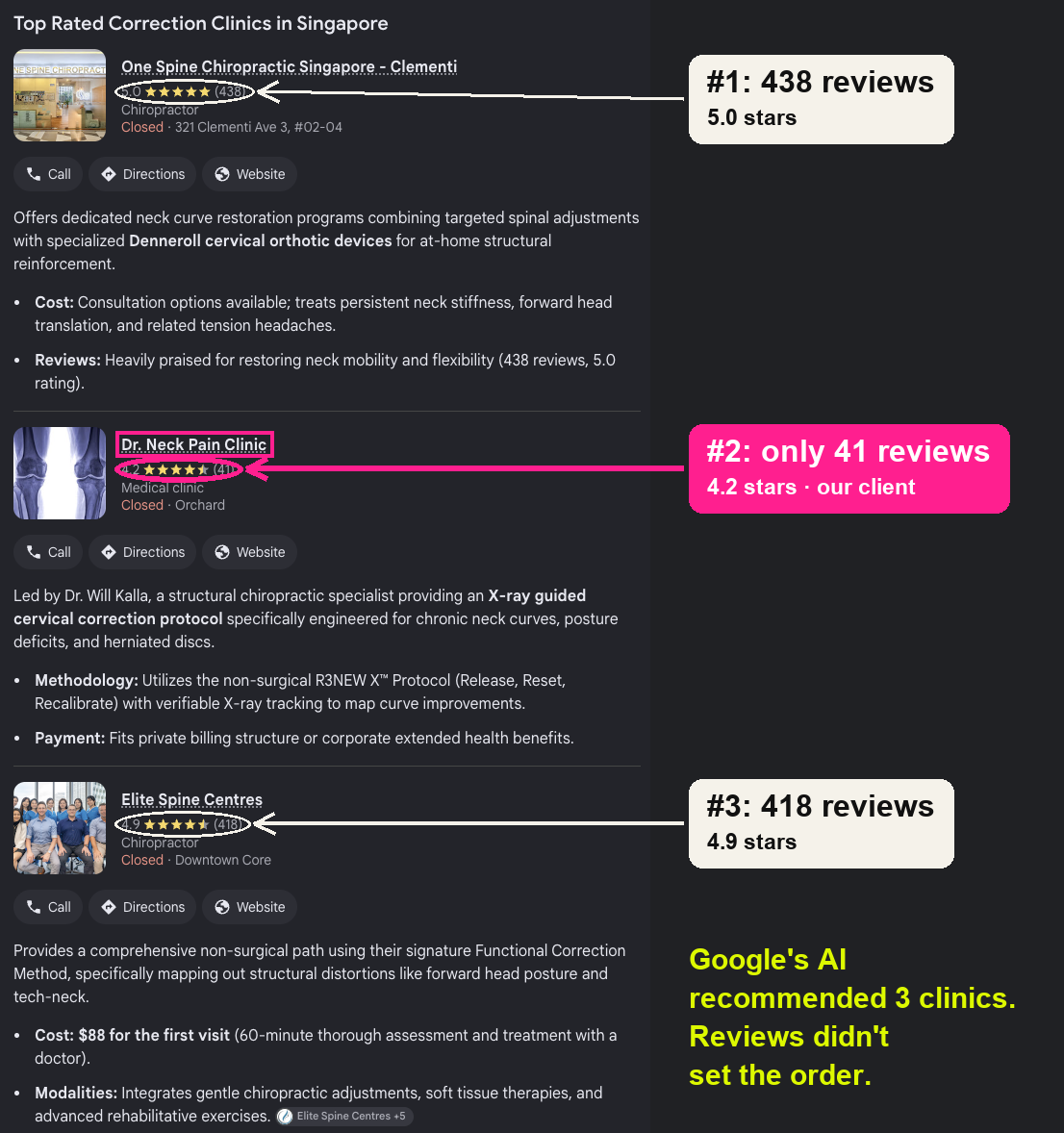
Google, Singapore, private window, 3 November 2026, 10:01pm. Markings are ours.
The same evening, for “chronic neck pain singapore specialist”, Google’s AI named only doctors and hospitals, as it should for a medical term. In the ordinary results, the clinic’s homepage was second, the only chiropractor on page one.
Reviews didn’t decide that order. In the weeks before, the clinic added no new guide to its own website. What kept running was MultiCasting, publishing about the clinic on other sites every week. One evening’s searches are a snapshot, not a promise, so we repeat the same searches every month. The full story, with two AI audits side by side, is in our Dr Neck Pain case study.
When you need more than an SEO agency in Singapore
An SEO agency gets your website right. What most SEO contracts leave out is the third tier from the three tiers above: getting your business talked about on other sites, so Google and ChatGPT name you, and answering fast when customers message. It’s worth a serious look when several of these are true:
- Your website works and people can find you by nameSo the floor is in place.
- You rank, but customers still pick a competitorOften one that is talked about more, not one that is better.
- AI answers name other businesses when customers ask about what you sellAnd changes on your own site haven’t moved that.
- Enquiries come in, but some wait hours for a replyAnd go quiet.
That’s the work we do. MultiCasting publishes your expertise on other trusted sites every month, so Google and ChatGPT find you mentioned in many places. Ranked. keeps your Google profile and reviews growing. Booked. answers your messages in seconds and books the slot. If you also plan to send offers to past customers on WhatsApp, read what the PDPA for WhatsApp marketing asks before you send. If you want the reasons in more detail, read why customers choose your competitor when your service is better, and see how a business gets recommended by ChatGPT.
Want to see who ChatGPT names when your customers ask about what you sell? We’ll check for free.
Run My Free ChatGPT Check ↗Questions owners ask about hiring an SEO agency in Singapore
Is SEO dead now that AI answers sit at the top?
No. Google says the same basics still apply to its AI answers. What has changed is that ranking alone is less of the story, because customers now see an answer before they see a list of websites.
Do I need an SEO agency if I already have a Google Business Profile?
Not always. If your website works and customers can find you by name, your profile, your reviews, and how much you’re talked about often matter more. The self-check above shows where your gap is.
How do I know if an SEO agency in Singapore is using shortcuts?
Ask question 6 (which websites will link to you, and do they pay them) and question 12 (what you’d still have if Google stopped rewarding it). Vague answers to either are your warning.
Is “GEO” or “AI SEO” different from SEO?
Mostly not. Google says there are no special requirements to appear in its AI answers. Ask the agency to list what its “AI” work does that normal SEO doesn’t, and what it costs on its own.
Do you offer SEO?
No. We work on being talked about and being chosen: MultiCasting, Ranked., and Booked. If your website itself is broken, hire a good SEO or web person first, using the questions above.
Hire for what you’ll still have next year.
Find out who ChatGPT names when your customers ask, and what’s missing on your side. Free, and you’ll see it in plain words.
Run My Free ChatGPT Check ↗References
- Google Search Central, Do you need an SEO? (guarantees, “special relationship”, secretive agencies, your responsibility for an agency’s work). Checked 4 November 2026.
- Google Search Central, Spam policies for Google web search (link spam, scaled content abuse, doorway abuse). Checked 4 November 2026.
- Google Search Central, Google Search spam updates (“any ranking benefit the links may have previously generated for your site is lost”). Checked 4 November 2026.
- Google Search Central, Google Search’s core updates and your website. Checked 4 November 2026.
- Google Search Central, A guide to Google Search ranking systems (Panda, Penguin, Hummingbird, helpful content system and their dates). Checked 4 November 2026.
- Google Search Central Blog, New ways we’re tackling spammy, low-quality content on Search, March 2024. Checked 4 November 2026.
- Google Search Central, AI features and your website. Checked 4 November 2026.
- Dr Neck Pain searches: our own captures, Google Singapore, signed out, 3 November 2026.
This guide is general information, not legal or technical advice for your website. Get Brand Exposure doesn’t sell SEO services. Search results and AI answers change from day to day.